|
SVS 20-39CS Passive Subwoofer
SV Sound 20-39CS Passive Subwoofer
Manufacturer:
SV Subwoofers LLC
www.svsubwoofers.com
Price: $479
Source: Manufacturer loan
Reviewer: Thomas A. Nousaine
What the heck is a "passive" subwoofer? Unlike other speakers, most modern subwoofers are powered, which simply means that a power amplifier and electronic crossover come as part of the package. A so-called "passive" subwoofer has all the acoustic stuff but you have to supply the electronics yourself.
Many modern receivers will have a modest electronic crossover. Fancier units such as my Lexicon DC-1 and MC-1 already contain an extensive subwoofer filter, but in either case you still have to supply the power separately. Many of us may have a separate amplifier channel hidden away in the closet so this may not be that big a problem for a long-time enthusiast.
The primary SV Subwoofer (SVS) products are a series of different sized 12-inch bass reflex passive subwoofers. They have now introduced a line of similar products, their "Powered Cylinder" subs, which include an internal 190-watt amplifier with an integrated crossover. None of the passive "Cylinder Series" subwoofers include any crossover, so either you must have one built into your current system or you'll need to purchase one separately. The Paradigm X-30 is an excellent moderately priced ($160) device to consider.
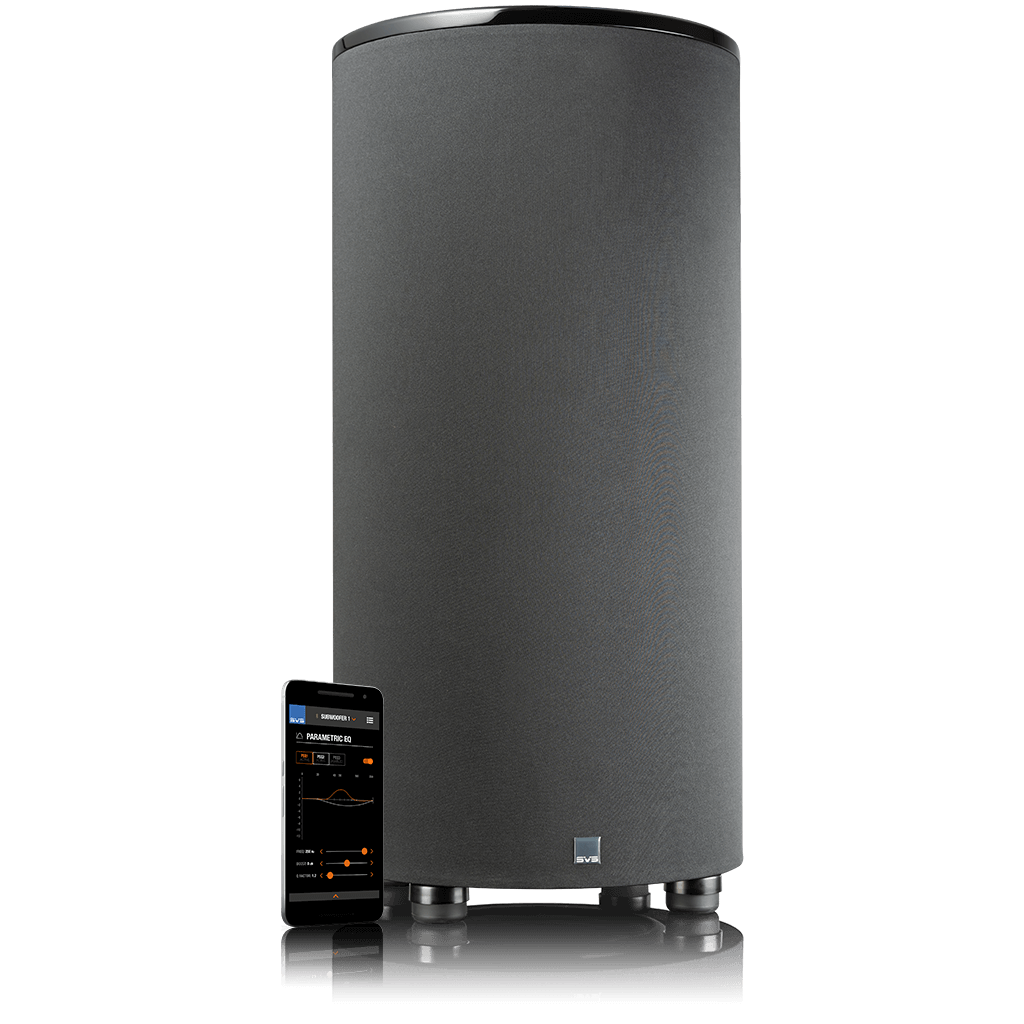
I tested the intermediate sized SV20-39cs, which is a tall tube 17 inches in diameter and 39.5 inches tall. It weighs only 36.5 lbs, mostly because it is primarily made from Sonotube, a cardboard-like construction product used as a construction concrete former. Ever wonder what held those concrete pillars on that overpass in place as the cement dried?
The SV20 has a good-stroke 12-inch woofer on its bottom-end held roughly 1.75-inches off the floor with a standoff panel. The dual banana input terminals are mounted on the bottom near the woofer. However, there isn't enough spacing to use dual banana plugs, so stripped leads or spade lugs are the order of the day. The top contains a 3.5-inch port facing straight upward, covered by a metal grille. The "cabinet" itself is covered with a black velvet-like sock. Overall the unit is well finished when compared to other Sonotube enclosures but it's still not fine furniture. When the light is exactly right you can faintly make out the Sonotube ridges under the sock, and you'll have to smooth the fabric after you handle the sub.
Any way you slice it, the SV20 looks like, well, a large black post. The tall cylindrical shape means it doesn't use much floor space, and mounting the woofer on the bottom stabilizes the cabinet nicely. A set of spikes is included in the price for those with thick nap carpet. The main difference between the different cabinet sizes is low-end extension. The SV16-46CS is tuned to 16 Hz and is 46 inches tall, the SV20-39CS is tuned to 20 Hz and stands 39 inches tall, and the SV25-31cs is tuned to guess what? Yes, 25 Hz, and yes, it's 31" tall.
The SV20-39cs is only available on-line at www.svsubwoofers.com and comes with a 45-day money-back guaranty, a 3-year warranty, and a list price of $479 including shipping. The only thing you may lose if you don't like yours is return shipping to Austintown, Ohio.
SVS also sells companion power amplifiers. They included a Fidek FPA-3002 600-watt 2 channel amplifier with my samples of the SV-20. The amplifier costs $379, $359 if you purchase a subwoofer at the same time. The package has a list price of $838. A second subwoofer makes the package price $1193. A 200-watt amplifier costs $319, $299 if purchased with a subwoofer.
Finally, the company offers a line of what seem to be the same products with a built-in 190-watt power amplifier. The SV20-39PC (for Powered Cylinder) sells for $750. The SV16-46PC costs $825 and the smaller unit lists for $675.
Inside Tips: Let's describe this product in more technical terms. The SV-20 is a vented low frequency system employing a 12-inch long throw woofer in a 3.75 cubic foot tubular enclosure. The system is tuned to 19.5 Hz with a 4-inch by 15-inch duct that is flared on both ends. The enclosure has an internal fiberglass lining. The minimum impedance is 4.75 ohms at the tuning frequency.
The system has frequency response of +/- 1.5 dB from 29 to 60 Hz when measured in the near-field (equivalent to anechoic). In a large 7500 ft3 room it measures +/- 2.5 dB from 25 to 75 Hz. In a 2000 ft3 room this equates to roughly 20-Hz low frequency extension. If you use a -6-dB band-limit point the unit has usable response from 20 to 100 Hz in the larger room. However, because it has a very low tuning frequency, it doesn't have flat response at higher frequencies. There is lots of output to 800 Hz or so. So you'll absolutely need that low pass filter.
It has excellent SPL capability. When held to a maximum of 10% distortion the unit cranks out a robust 91 dB at 20 Hz and averages 109.5 dB in the 25-62 Hz region and 106.4 from 20 to 62 Hz. Maximum SPL is 114.9 dB at 32 Hz. These levels were attainable without ever once lighting the clip indicators on the 300-wpc Fidek amplifier. I would guess that the powered models have similar output These numbers were taken in-room at 2 meters @ 7500 ft3. For a 2000 ft3 room add 2.5 dB to the 25-62 Hz range and 3.6 dB to the 20 to 62 Hz numbers. Add 6 dB for a second subwoofer placed adjacent to the first or 3.5 dB for a second one placed in a different corner.
Using program material the SV20 whacked out 118 dB on Bass Ecstasy's "Bass Erotica" and 112 dB with Telarc's "Jurassic Lunch" and the cannon shots from the "1812" (again, in-room at 2 meters). The lower frequency content on the latter two allowed the unit to bottom its driver more quickly. A 16 or 20 Hz high pass filter would help immensely here as the driver has no restoring force below the 20 Hz tuning frequency.
Summary: This is serious bass. Easily the best current value on a dB per-$ basis. But it's not necessarily as inexpensive as it looks on paper. You will need an amplifier and electronic filter. If you buy the Fidek and a Paradigm X-30, the set will cost you a nearly grand. It still buys you more output than any other $1,000 you spend, but it's not exactly frugal. However, if you have a spare amplifier channel and your receiver has a built-in crossover (such as in all Dolby Digital receivers), you can get world-class bass for under $500. That's a fantastic deal.
About the Fidek amplifier. It looks great. The controls and function are decent and it has more than enough power to drive the SV-20. At 60 cents per watt, it's cheap. But it has a really loud cooling fan that runs all the time. If you can install it in a closet or another room that's a moot point, but the fan is way too loud for my taste. (SVS reports that primarily because of this complaint [echoed by their customers], they have stopped carrying the Fidek amps and have replaced them in their line with Samson S-700 amps. While they are still fan cooled, they are said to be dead quiet. They are also a bit more powerful 350 watts vice 300 and a bit more expensive. The amp alone is $425, and the packages TAN cites are now $858 for the single sub/amp [was $838] and $1,244 for a dual sub package [was $1,193]. -KWN)
You'll notice that I haven't bored you with a lot of BS about how fast and tight the bass, how it unveils several layers of low-frequency detail, and so on. Well, that's because after testing a couple hundred hi-fi, home theater, and car subwoofers (and building a few dozen or so), I've learned that a subwoofer's "sound" and its worth can be almost completely described by its measured performance and operating characteristics.
Heresy you say? Well hold on for a moment. Sound gets harder and harder to reproduce as frequency falls. For example; to reproduce 20 Hz at a given SPL requires a displacement four times that of 40 Hz, which in turn is four times that of 80 Hz. The hardest thing for a subwoofer to do is to go low and play loud. Smoothness is the next required attribute, but that is much easier to accomplish.
When it can do justice to the lowest and loudest spectral content of the program with smooth frequency balance, a subwoofer will deliver the goods in a subjectively perfect manner. Indeed, at lower frequencies your room will have a bigger effect on the spectral balance than the subwoofer itself. In other words, the SV-20 will deliver most programs that have significant low frequency content with the subjective transparency allowed by your room.
It has fantastic output down to 25 Hz, which puts it in the class of products that cost $2000 and more. It's not perfect. It can be overdriven, producing disturbing noises when you go past the limit. Once the system is set up and balanced this will usually not be a problem until you get new programs with even greater low frequency content.
Features are important as well. Most powered subwoofers have a decent set of electronics that enables system matching to most conceivable speaker systems. The SV-20 lacks any electronic capability, which is its primary drawback.
So what do you hear with a good subwoofer? Well, for one, if you listen to stage drama, pop, jazz, and light classical, you may well hear nothing different! A subwoofer is only useful when the program has high SPL and low frequencies. There was precious little bass content (below about 50 Hz) in the LP analog days. CD changed all that and now there are plenty of programs with content down to 16, 10 or even 5 Hz. These are primarily organ pieces, sound effects (cannons, synthesized dinosaurs) and environmental recordings (aircraft, space launches, etc). If these programs aren't of interest to you, then perhaps you don't need a subwoofer.
On the other hand, subwoofer is important to realistic playback of films with enthusiastic soundtracks. Most movie soundtracks, up until about two years ago, had a low frequency band limit of 25 Hz, basically to protect the cinema subwoofers from overload. However, 25 Hz is well beyond the capability of all but a few large full range speakers. Furthermore, impressive soundtracks with much lower content which have been released recently. Check the SVSubwoofer web site for some interesting pictures.
What you actually hear is a sense of intensity (in the psychological meaning) and spaciousness that was lacking beforehand. The organ in the cathedral seems to be in a much larger space. The thunder report has that scary crack and that satisfying realistic long fade away which was absent before. You can feel the approach in the floor and the wreck shakes the couch. The driving bass can be felt in the sternum even at relatively low playback levels.
With a properly set-up subwoofer and a properly set-up main system there should be absolutely no difference in sound except when the program has that deep bass content. The basic tonal balance of your main speakers will not change (unless they were bass-shy to begin with), the spatial characteristics will not change other than the enhanced sense of envelopment.
You will notice a basic improvement in the sense of dynamics when there is significant low frequency content. For example, many sub-less systems have a decided spectral shift at high playback levels where the mids and highs keep increasing in level while the bass remains stagnant. A good sub keeps pace dynamically.
There is one other interesting way a good sub can help the whole system. At low frequencies the primary in-room problem is an uneven distribution of bass energy because of low modal density. When you place the speaker handling the low frequencies anywhere other than in a corner you will necessarily fail to excite some modes and exacerbate the problem. This almost always happens with full range stereo speakers for example. When you install a subwoofer, crossed over suitably low (say 80 Hz), strategically placed in a corner, you can significantly improve the overall distribution of energy in the room because you will excite all the possible modes. The low-frequency energy distribution will still be uneven but it will be as equally distributed in a given room as possible.
The SVS 20-39cs subwoofer is an excellent way to get better sound, although you must spend some of your own energy when you choose the passive subwoofer route. But the chase is often the best part of any adventure. This product provides an economical, high performance upgrade to any existing sub-less system when you expect high-quality bass or if your present system isn't truly satisfying at the lower end. It can be frighteningly inexpensive if you already own a spare amplifier channel and have access to an electronic low pass filter. Even if you must purchase an amplifier and crossover it offers the most performance a $1,000 bill can buy today.
-TAN
Reprinted with permission from The Sensible Sound, Issue 86. For subscription information, please call toll-free 1-800-695-8439 or write 403 Darwin Dr., Snyder NY, 14226.
|
|
 |
|
 |
Questions? Call: (703) 845-1472 or Toll Free (877) 626-5623 or E-mail us at: sales@svsound.com | Copyright 2005 - 2008 SVS |
|
Web Site Visual Design: SVS and FATHOM
Application Development: Robb McNabb
Privacy Policy
|
|
|